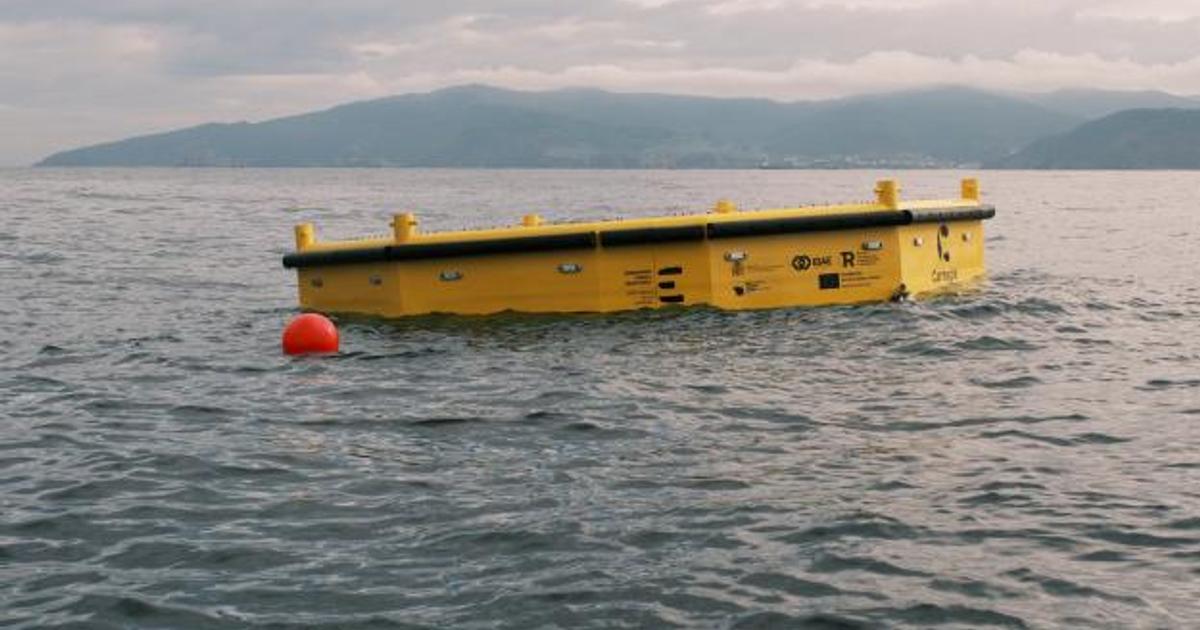
Prior to deployment, the three modular sections of the CETO BA were transported from the local Basque fabricator to the Port of Bilbao, where they were assembled quayside. The CETO BA was then lowered by crane into the water and docked alongside the quay, ready for transport to site. On Saturday, the CETO BA was towed from the port to Carnegie’s pre-permitted offshore berth at BiMEP, where it was connected to a bespoke installed mooring and anchor system. Following the successful deployment, the CETO BA will remain at the offshore site for a short period before being retrieved and brought back to port at the end of the current weather window.
The Stage 1 deployment is a short campaign deploying the CETO BA to validate marine procedures and BA behavior in real ocean conditions while under tow and at Carnegie’s BiMEP berth. The process of deploying the CETO BA at BiMEP has provided valuable operational insights across the necessary local and port authorizations, supply chain logistics, and offshore execution, which provide increased certainty for subsequent full CETO system operations.
As part of this first deployment, Carnegie successfully navigated and secured the necessary operational clearances and authorizations from port and maritime authorities covering quayside assembly, heavy lifting, port and offshore transit, and offshore installation. These activities were valuable in establishing and validating practical local supply chain workflows and logistics.
At the Port of Bilbao and BiMEP, the team successfully coordinated and executed the anchor and mooring system deployment, towing procedures, vessel coordination, and offshore mooring hook-up. The activities were led by Carnegie’s Chief Technology Officer (CTO), who draws upon a wealth of experience, gained through deploying Carnegie’s previous CETO array in Australia and leading the CETO design and innovation process since then.
Through this hands-on marine execution, Carnegie’s entire team has gained vital local offshore operations experience, expanding internal team capacity to manage complex offshore campaigns within the Basque Country.
This experience provides increased technical and logistical certainty for subsequent deployments as Carnegie prepares for the full Stage 2 grid-connected deployment scheduled for European spring 2027. In addition, the successful completion of these activities unlocks key funding milestones and financial support under the ACHIEVE Program’s funding framework.
The CETO BA is scheduled to remain on site for a brief period before the team retrieves the device, again testing and validating offshore logistics and supply chain capability to bring the unit safely back to port. The retrieval of the CETO BA and tow back to port is being scheduled around suitable weather windows and vessel availability. The time deployed on site for Stage 1 is short given the key objectives of Stage 1 deployment are focused on validating offshore logistics, installation and retrieval activities as well as funding milestones.
Over the European winter months, the CETO BA will be kept onshore in the port while the PTO Modules undergo final onshore testing locally. The onshore testing includes a series of tests with the PTO Modules and the Electrical Module simulating real ocean conditions to validate mechanical, electrical, control, and communications functions. Following this, the Stage 2 deployment is expected in European spring, where the fully integrated CETO system will be deployed at BiMEP and grid-connected. While the CETO system is designed to operate year-round, the standard industry practice is to deploy and grid-connect a prototype for the first time during the most benign weather conditions (late spring–summer), enabling any troubleshooting to occur easily during the first months of operations and progressively exposing the prototype to more extreme conditions.
Carnegie Chief Executive Officer Jonathan Fiévez commented: “Seeing the CETO BA in the water offshore at the BiMEP site is a proud moment for everyone at Carnegie. It has taken a mammoth effort from our team in Bilbao to ensure the Stage 1 deployment has been a success. Whilst this is just the first stage of offshore campaign, the experience gained from this short deployment has increased our team’s capabilities and put us in a much stronger, more certain position as we push toward our full grid-connected Stage 2 deployment in European spring 2027. This is an ambitious project given the large technology leaps we’re taking so executing it in stages and conducting substantial onshore testing are important to manage risk.”