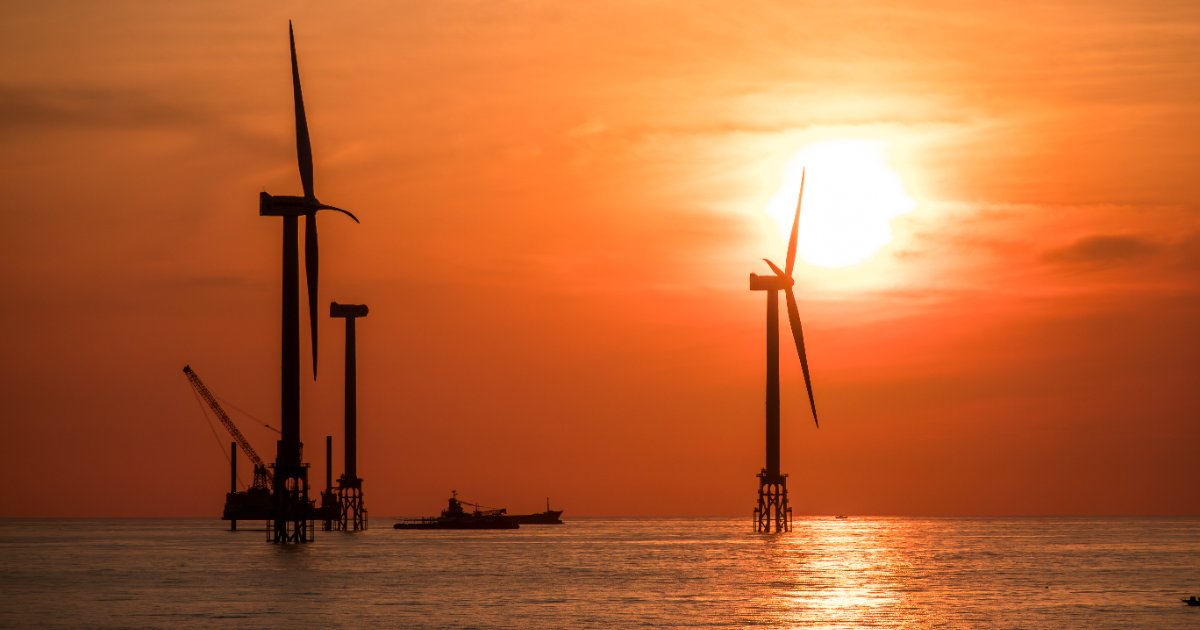
But our understanding of the conditions beneath the seabed is still limited.
Unlike the world above ground, which can be surveyed in detail, engineers often have only sparse and mixed-quality information about conditions underground or beneath the seabed. Investigations are expensive and time-consuming, while gaps in knowledge can lead to costly problems later.
Now, as part of a new £39 million UKRI investment in 20 AI research projects, Dr. Roisin Buckley of the University of Glasgow will develop new artificial intelligence (AI) tools to help engineers build a much clearer picture of underground and seabed conditions using less data.
Her team will combine AI with established principles from physics, geology, and engineering to unlock the value of vast quantities of geological, geophysical, and engineering data. The technology will also identify gaps in knowledge and show how certain its predictions are, allowing developers to target further investigations where they are most needed.
The potential savings are significant. Subsurface investigations for a wind farm can currently take place over around 10 years and cost tens of millions of pounds. Unexpected conditions beneath the ground or seabed can also have enormous consequences: one Scottish offshore wind farm wrote off €106 million because of unforeseen subsurface challenges.
Working with Scottish Power Renewables, Dr. Buckley’s team has already assembled one of the world’s largest curated databases of subsurface data. This will provide the foundation for developing AI tools that could eventually be transferred between development sites.
Dr. Buckley, a senior lecturer in the James Watt School of Engineering, said: “I am delighted to have been awarded this Fellowship and grateful to UKRI for placing their confidence in me and the interdisciplinary team we are building at Glasgow.”
“Delivering renewable energy infrastructure at pace is one of the greatest challenges facing society and will require expertise from across engineering, geoscience, and artificial intelligence. By bringing these disciplines together, we have an opportunity to fundamentally transform how we understand the subsurface and develop the infrastructure needed for the energy transition.”
“Supported by ScottishPower Renewables, my team has already gathered the world’s largest curated database of onshore and offshore subsurface data. Working with my co-lead, Professor Mark Girolami, we will develop new AI methods that combine physical understanding with real-world data to reduce uncertainty, improve decision-making, and accelerate the deployment of offshore renewable energy infrastructure. Ultimately, we aim to replace traditional multi-stage investigations with quicker, lower-cost surveys that still deliver reliable information.”
She hopes the research could ultimately change how offshore wind farms are developed, significantly cutting the time and cost involved, while giving engineers greater confidence in the decisions they make. The approach could also be applied to transport, telecommunications, nuclear energy, and carbon capture projects.
The project forms part of a wider cohort of 20 new Turing AI Fellows who will use artificial intelligence to tackle challenges ranging from healthcare and clean energy to climate science, nuclear safety, and historical archives. Together, the fellowships are backed by more than £39 million in funding from UKRI.