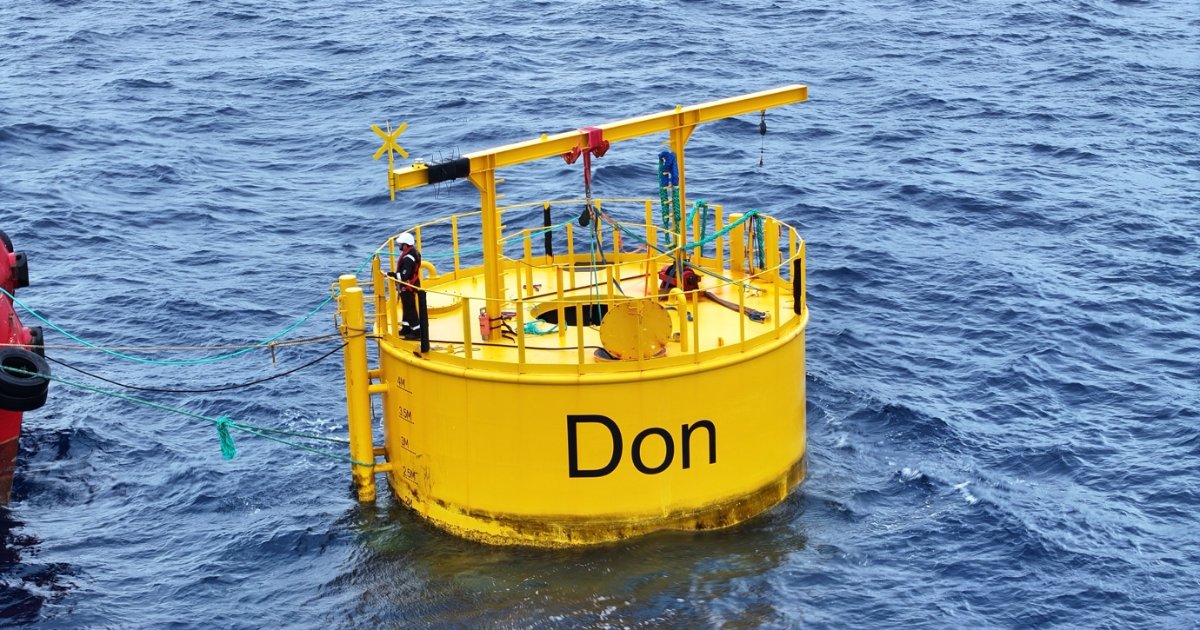
The prototype was built under the PLOTEC project, awarded €3.5 million by Horizon Europe in 2022. It was installed in October 2025 at PLOCAN, a pre-consented marine technology test site off Gran Canaria. A full year’s testing at sea addresses one of the longest-standing barriers to scaling OTEC for islands and coastal communities in the tropics and sub-tropics: proving that a floating platform can survive the open ocean.
The test period included some of the harshest weather in recent Canary Islands history. According to Spain’s national weather agency, the Agencia Estatal de Meteorología (AEMET), the 2025 to 2026 season brought 19 named storms. That is the highest number since the current storm-naming system began in 2017. The platform proved its resilience and operational capability through all of them.
Onboard sensors recorded a maximum wave height of 5 meters. For a full-scale system, that is equivalent to a 30-meter wave height.
Sam Johnston, Lead Engineer responsible for the development of the prototype and the offshore test phase, said: “This project really helped advance our riser installation methodology and solidified the path forward for future OTEC deployments in storm-prone environments. We couldn’t have asked for more challenging conditions for testing.”
OTEC generates continuous renewable electricity from the temperature difference between warm surface water and cold deep ocean water. It has been demonstrated onshore at small scale, at sites that already have deep ocean water intakes. On land, however, the size and length of the seawater pipes have limited how big those systems could get. Moving OTEC offshore reduces the pipe length needed by 80%, which opens up the scale required for meaningful power generation in island markets.
Today, most electricity in tropical island nations comes from diesel and heavy fuel oil, leaving these economies exposed to volatile fuel prices and high energy costs. Wind and solar have been deployed, but their expansion is often limited by scarce land availability and difficult seabed conditions close to shore. As a result, many islands face structural barriers to reliable, large-scale renewable power.
OTEC draws on a tropical island’s largest natural resource: the ocean. Operating offshore, it provides continuous baseload electricity without competing for land and without the intermittency of wind and solar. Global OTEC has identified over 25 GW of existing fossil fuel capacity across tropical islands that OTEC systems could replace over time.
Until now, engineering challenges have held back offshore OTEC. The PLOTEC prototype has shown that a floating OTEC platform can operate through a full year of open-ocean conditions, including the vertical seawater intake riser, widely considered the most complex element of an offshore OTEC system.