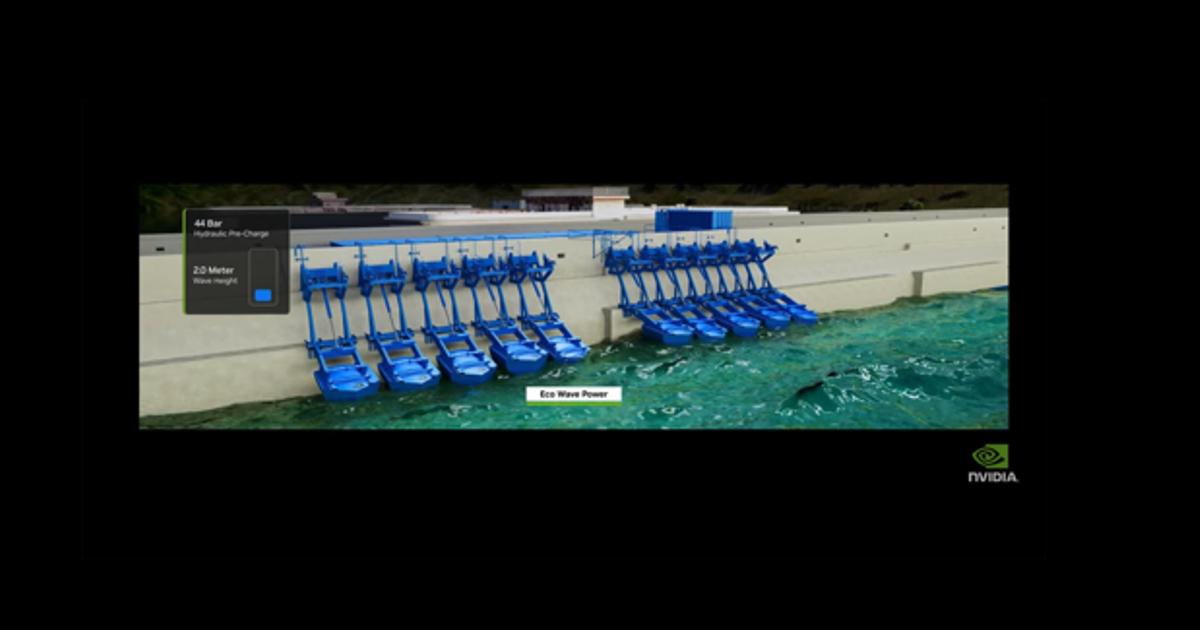
The collaboration advances Eco Wave Power’s strategy to integrate artificial intelligence (AI), physics-based simulation, machine learning, and Digital Twin technology into the design, monitoring, and optimization of its wave energy systems. Both Eco Wave Power U.S. and AI engineering are members of the NVIDIA Inception program. Building Digital Intelligence Around Wave Energy. Under the agreement, the companies have commenced Phase 1 of the “Eco Wave Power – Digital Twin & Energy-Aware Computing” project, combining advanced physics-based simulation with Eco Wave Power’s real-world engineering, wave, and operational data.
The initial phase will focus on digitally modeling how ocean waves interact with Eco Wave Power’s proprietary floaters. Using AI engineering’s PAMICS simulation technology, the companies will evaluate floater behavior, structural loads, and theoretical energy input under different sea conditions.
The companies also plan to compare simulated results with real-world sensor measurements and begin developing machine-learning capabilities for forecasting energy yield and system loads.
A key objective is to determine how the Digital Twin can be adapted to different project locations, potentially allowing Eco Wave Power to transfer engineering knowledge and operational insights more efficiently as it expands into new markets.
“For us, AI is not simply a software layer that we add to our technology—it is an opportunity to fundamentally improve how we understand, design, predict and ultimately operate wave energy systems,” said Inna Braverman, Founder and CEO of Eco Wave Power.
“Phase 1 of this collaboration is therefore very practical. We will model wave loading, floater behavior, structural forces and theoretical energy input, while beginning to develop machine-learning capabilities for forecasting loads and energy yield. Importantly, we will also examine how those models can be transferred to new sites with different wave conditions.”
Supporting Eco Wave Power’s AI Strategy
The agreement follows a series of AI-related developments for Eco Wave Power during 2026.
Eco Wave Power believes artificial intelligence presents two complementary opportunities for the Company: to make its proprietary wave energy technology increasingly intelligent, predictive, and scalable; and to position wave energy as a potential renewable energy source for the rapidly growing electricity requirements associated with artificial intelligence, data centers, and digital infrastructure.
During 2026, Eco Wave Power’s technology was featured twice in keynote presentations by NVIDIA Founder and CEO Jensen Huang. Eco Wave Power U.S. also joined the NVIDIA Inception program, and the Company was featured in an NVIDIA corporate blog examining its use of AI infrastructure and Digital Twins and exploring the longer-term potential for ocean-powered data centers.
For the current collaboration, NVIDIA technologies used include NVIDIA Omniverse for Digital Twin visualization and simulation workflows and NVIDIA Warp as part of the project’s simulation and modeling toolchain.
Eco Wave Power believes that combining advanced physical modeling, accelerated computing, machine learning, and real-world operational data could ultimately support faster engineering optimization, improved forecasting, and more efficient deployment of its technology across different geographic markets.
Combining Advanced Simulation with Real-World Data
AI engineering GmbH specializes in applied fluid mechanics, numerical flow simulation, and high-performance computing. Its PAMICS technology is a particle-based multiphysics simulation framework designed for complex fluid dynamics and fluid-structure interaction applications.
“Wave energy is a particularly challenging engineering problem because it combines complex free-surface fluid dynamics, structural motion, and highly variable environmental conditions. Our goal is to create a physics-based digital representation of Eco Wave Power’s system that links high-fidelity simulation with operational data. This approach allows us to better understand energy capture, structural loading, and system behavior across a wide range of sea states. Over time, combining these physics models with machine learning can support more accurate forecasting, design optimization, and scalable deployment of wave energy technology,” said PD Dr.-Ing. habil. Stefan Adami, Co-Founder and General Manager of AI engineering GmbH.
Eco Wave Power currently has projects and development activities across the United States, Europe, and Asia, including its grid-connected project at Jaffa Port in Israel, its Port of Los Angeles pilot, and projects under development in Portugal, Taiwan, and India.
“Our physical technology converts waves into electricity. Our objective now is to build the digital intelligence around that technology,” Braverman concluded.
“As our projects grow from pilot installations toward megawatt-scale deployment, we believe Digital Twins and AI can help us learn faster, optimize more efficiently, and transfer knowledge from one project to the next.”