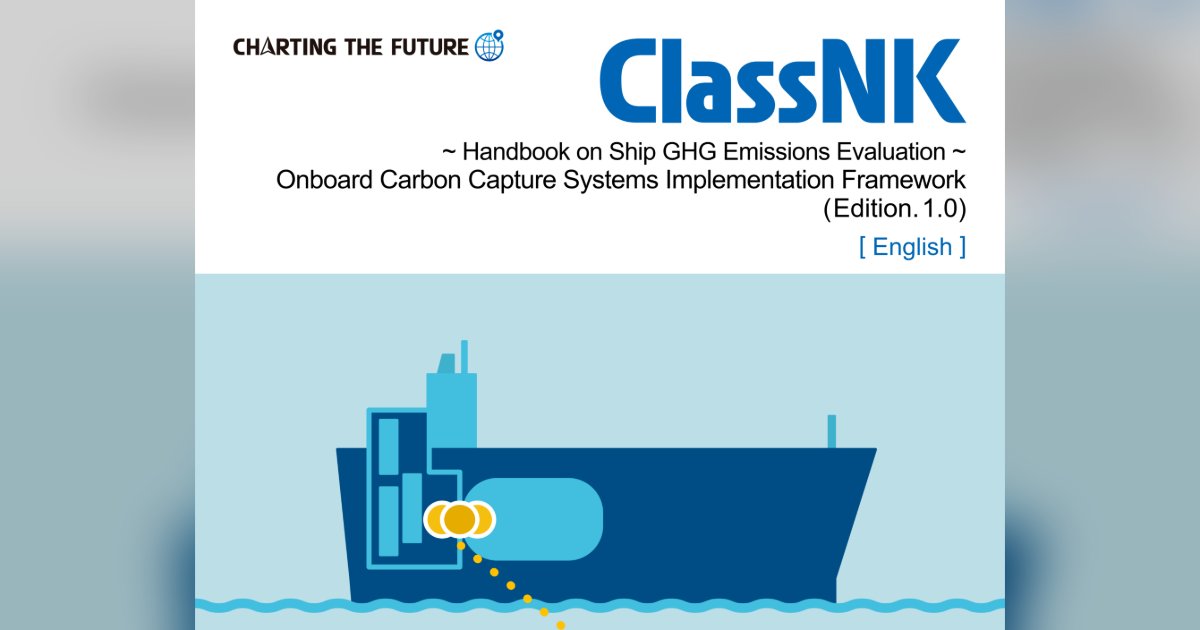
The handbook provides practical guidance for shipowners, operators, and other stakeholders considering the introduction of onboard carbon capture systems (OCCS). It is intended to help them understand the considerations involved across an entire OCCS project and to facilitate discussions among relevant parties and consideration of OCCS implementation.
The introduction of OCCS requires consideration not only of the value chain from onboard CO2 capture through to storage and other forms of final treatment, but also of mechanisms for quantifying and verifying emissions reductions.
These include Monitoring, Reporting and Verification (MRV) and Chain of Custody (CoC) systems for managing captured CO2 and its associated attribute information.
The handbook brings together these considerations from technical, infrastructure, regulatory, and emissions-reduction assessment perspectives, and can be used to support discussions among relevant stakeholders and the consideration of specific OCCS projects.
The maritime industry is pursuing various measures to reduce greenhouse gas (GHG) emissions, including operational improvements, the introduction of energy-efficiency technologies, and the transition to alternative fuels.
Among these options, onboard CO2 capture, in which CO2 is captured from ships’ exhaust gas, processed, and temporarily stored on board, has attracted attention as a means of supporting GHG emissions reduction, with demonstration projects and discussions on relevant regulatory frameworks progressing internationally.
However, translating the use of OCCS into actual emissions reductions requires more than the onboard system itself. Routes must be secured for the unloading, transportation, storage, sequestration, or utilization of captured CO2, together with mechanisms for quantifying and verifying emissions reductions.
As these considerations span technology, infrastructure, regulation, and emissions-reduction assessment, a project-wide perspective is essential.
Through the development of its “Guidelines for Onboard CO2 Capture and Storage Systems,” ClassNK has worked to establish safety and technical requirements for such systems, while accumulating knowledge through demonstration projects and experience through various GHG certification services.
Drawing on this knowledge and experience, the handbook has been prepared to help stakeholders considering the introduction of OCCS gain a project-wide understanding of the relevant considerations.
ClassNK will continue to support the maritime industry’s decarbonization efforts through the provision of relevant information.
The handbook is available on the following page of ClassNK’s website: www.classnk.or.jp