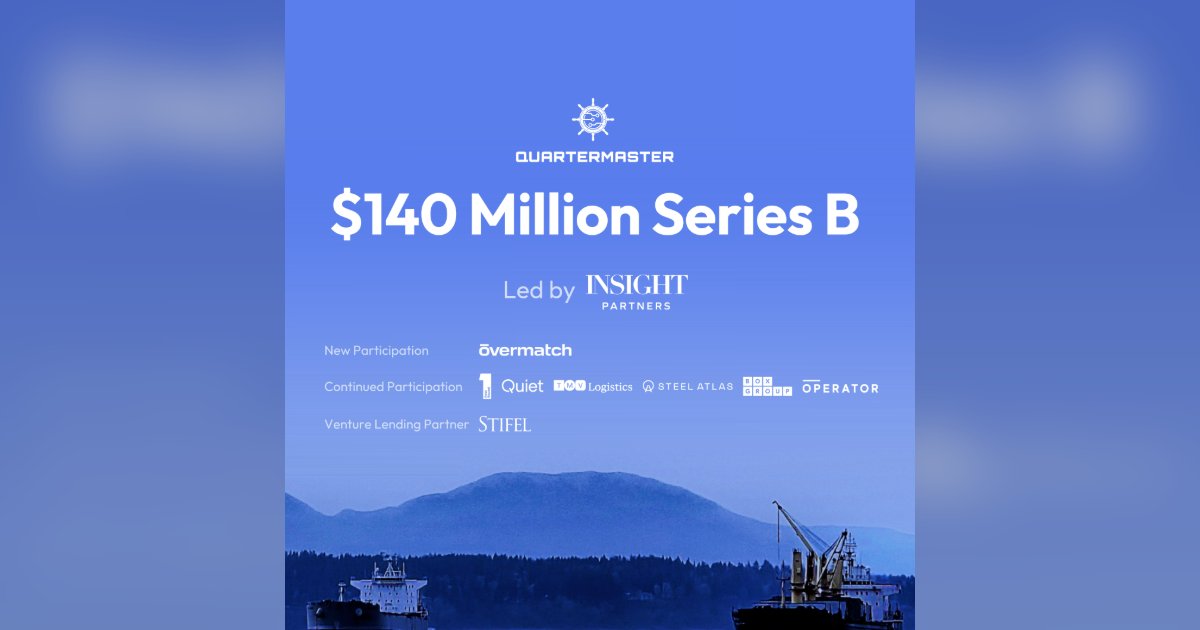
Overmatch Ventures joins the Series B as a new investor. First Round Capital and Quiet Capital, which co-led Quartermaster’s $43 million Series A in May 2026, returned for the round, alongside Steel Atlas, TMV, BoxGroup, and Operator Partners. According to the company, it had not planned to raise again this year, but accepted a preemptive offer from Insight as the gap widened between what fleets need and what existing offerings provide. The new capital will fund engineering hires and the recruitment of additional vessels to extend coverage across the world’s most active fishing grounds and commercial shipping lanes.
The raise follows a turbulent year for commercial shipping in the Gulf. In late February, military jamming and spoofing of navigation signals—used to defend against drones and missiles—left commercial vessels in Emirati, Qatari, Omani, and Iranian waters receiving false positions. Quartermaster frames the Strait of Hormuz closure that followed, now approaching seven months, as an economic problem as much as a military one. Economists at the Dallas Fed attributed the initial closure mainly to the need to adjust insurance contracts for oil tankers; several major underwriters stopped writing the region in March, and war risk premiums for a Hormuz transit in July reached 7–10 percent of a ship’s insured value per voyage, more than 30 times February levels.
Neil Sobin, CEO of Quartermaster, wrote that one of the world’s most important maritime chokepoints closed not because of drones or mines “but because of an actuarial table.” The risk, he argued, could not be priced because no one had a clear, objective picture of conditions in and around the Strait.
Quartermaster’s answer is physical presence on the water. The company contrasts its approach with automatic identification system (AIS) broadcasts, satellite navigation, radio frequency geolocation, and orbital imaging, which it characterizes as secondhand or remote signals. Its SmartMast sensor units are installed on working vessels—more than 650 across 25 countries, mostly small operators—at no cost to the operator beyond mast space. Operators receive the hardware, installation, and support, along with access to their own feeds, hazard alerts along their route, and broadband internet at sea. In return, SmartMast data feeds the network, which Quartermaster offers to insurers, fleets, and energy operators.
The company positions that network as the missing ocean layer in the datasets behind AI for trade, energy, and logistics—data it argues cannot be gathered from orbit or modeled from afar. With the Series B and debt facility in place, the next phase centers on engineering growth and bringing more vessels into the network.