- ABS reviewed bound4blue’s methodology for producing the aerodynamic polars used to build the wind propulsion system force matrix for Pwind calculation.
- Third-party review provides shipowners with a credible, regulation-ready pathway to quantify the contribution of eSAIL installations for Energy Efficiency Design Index (EEDI)/Energy Efficiency Existing Ship Index (EEXI) and FuelEU Maritime compliance.
- Independent review reinforces confidence in bound4blue’s computational fluid dynamics (CFD)-based approach and supports faster, more efficient deployment of future wind propulsion projects.
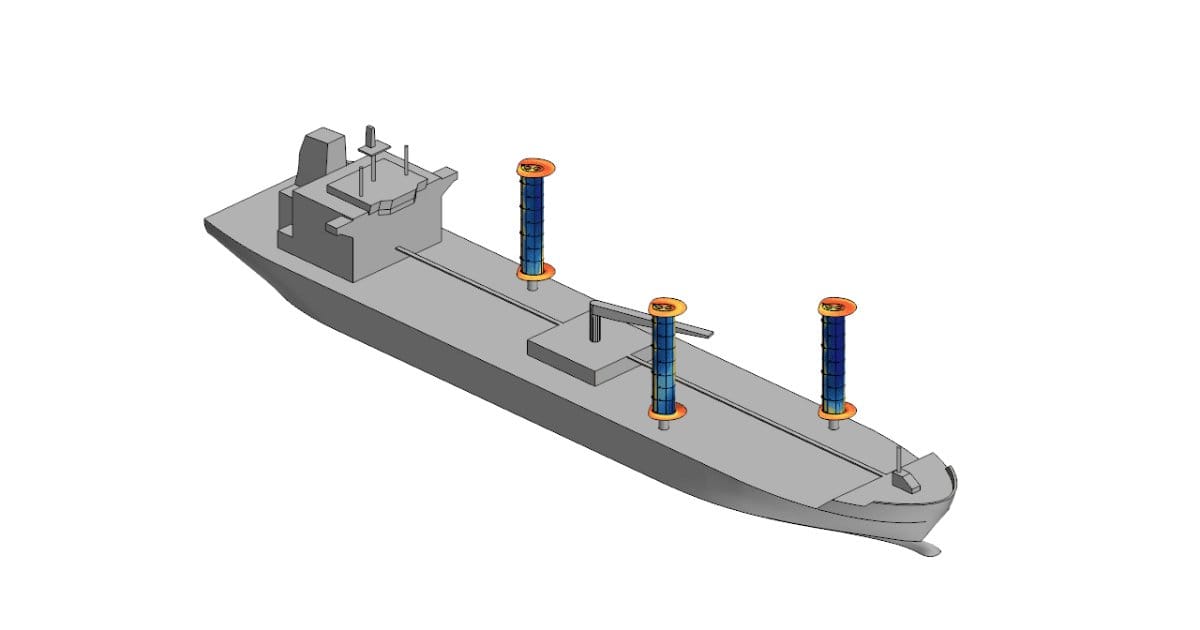
Wind propulsion pioneer bound4blue has achieved another milestone, with ABS review of its proprietary force matrix methodology for calculating Pwind values. The independent review adds to the growing number of classification society assessments of bound4blue’s methodology, giving shipowners added confidence when quantifying regulatory and financial benefits of eSAIL suction sails, helping accelerate adoption and streamline compliance.
bound4blue’s approach aims to deliver both confidence and speed. The innovative methodology combines advanced CFD modeling with wind tunnel-validated tools to generate vessel-specific aerodynamic force matrices. As such, it avoids the need for expensive and time-consuming full-scale testing, while still accounting for both sail-to-sail and ship-to-sail aerodynamic interactions. This ensures each installation is assessed according to its unique configuration and operating characteristics.
Achieving such reliable calculations is an increasingly important regulatory step for shipowners looking to embrace clean, readily available, and proven wind power. Verified Pwind values can be used within EEDI and EEXI calculations, while also helping to determine FuelEU Maritime’s Wind Reward Factor. While such methodologies do not indicate factors such as fuel savings or hydrodynamic performance, they do shed light on reduced compliance costs, strengthening the overall business case for wind propulsion.
José Miguel Bermúdez, CEO and Co-Founder of bound4blue, commented: “In a transitioning and increasingly complex industry, third-party reviews deliver both certainty and transparency for shipowners considering suction sail installations. That is a vital factor in accelerating the adoption curve for advanced wind propulsion technology.”
Bermúdez continued: “Independent review from leading Class Societies such as ABS gives stakeholders confidence that the aerodynamic methodology behind our Pwind calculations is robust, credible, and suitable for regulatory use. This creates a clear pathway to compliance, making it easier for shipowners to capture not only the environmental benefits of wind propulsion, but also the significant financial advantages available through today’s regulatory frameworks.”
The review also supports that bound4blue’s methodology can be applied with confidence across future projects. While each wind propulsion system force matrix remains specific to an individual vessel and installation, the underlying process has undergone expert third-party assessment, unlocking reduced project development and approval timelines for future eSAIL installations.
According to Alberto Llopis, Head of Aerodynamics at bound4blue, the achievement reflects years of investment in aerodynamic research and validation.
“The focus of this review is the generation of accurate aerodynamic polars and force matrices that represent how eSAIL systems perform under different wind conditions. Our methodology combines sophisticated CFD calculations and in-house tool development with extensive wind tunnel validation to provide insights into complex aerodynamic interactions. We’re delighted to have worked with ABS, as we continue in our quest to build confidence and credibility for wind power amongst shipowners, financiers, charterers, and other key stakeholders.”
Michael Kei, ABS Vice President of Technology, said: “ABS is committed to supporting the safe adoption of innovative technologies that help the industry comply with evolving regulations. We are pleased to work with bound4blue on their technology, helping provide a clear and consistent framework for evaluation of wind-assisted propulsion systems and supporting informed decision-making across the industry.”
The methodology used by bound4blue to determine the force matrix from the combination of Reynolds-averaged Navier–Stokes (RANS)-based CFD simulations, wind tunnel model tests, and potential-based interference analysis for multiple installations of eSAIL was reviewed in accordance with applicable IMO Regulations and International Towing Tank Conference (ITTC) Guidelines.
bound4blue has cemented its position at the forefront of the wind propulsion segment with a stream of high-profile contracts and installations for its autonomous, suction sail technology.
eSAILs generate forward thrust up to seven times greater than conventional rigid sails of the same size. By harnessing wind as a clean energy source, they ease engine loads, reduce fuel consumption, and decrease greenhouse gas emissions, supporting both regulatory compliance and financial performance.
The mechanically simple, non-ATEX units are suitable for a broad range of vessel types, including tankers, bulkers, ro-ros, cruise vessels, ferries, gas carriers, and general cargo vessels. The company has deployed eSAIL systems on 11 ships, with seven more in its order book, representing more than 50 eSAILs.