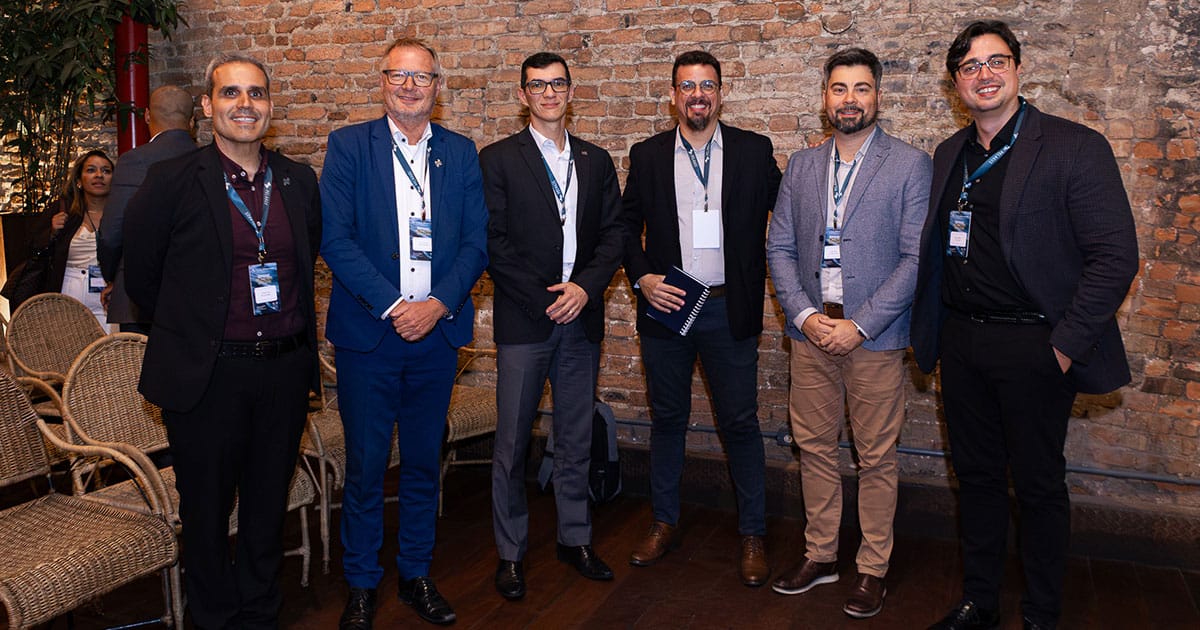
New strategies to boost the production, aftermarket service and availability of parts for Brazil’s maritime and energy customers provided the focus for a gathering staged by Pelagus and Belga Marine in Rio de Janeiro on April 16.
Reinventing The Spare Parts Supply Chain brought together OEMs/genuine makers and asset owners to discuss the challenges posed by long lead times, supply chain disruptions, and operational bottlenecks in Brazil. The event is expected to provide a template for similar market engagements in other locations.
Pelagus, a joint venture between thyssenkrupp and Wilhelmsen, works with OEMs and third-party manufacturers to enable on-demand parts production, through conventional and additive manufacturing. Belga Marine partners with Pelagus within the Brazilian market.
Bjorn Madsen, Pelagus chief commercial officer, Adhemar Freire, senior energy advisor for Brazil, Norwegian Energy Partners and Jan Lomholdt, honorary consul of Sweden and chief executive officer of Belga Marine, set the stage for what proved to be a thought-provoking evening.
“In Brazil we see a lot of opportunities around aging assets. Equipment is getting older and, in many cases, there is limited appetite to invest in retrofits or the latest upgrades when a vessel may only operate for another year or two. It therefore makes sense to offer equipment life extension options by continuing to supply the legacy portfolio through on-demand manufacturing,” said Madsen.
“This is where OEMs can potentially look at models like on-demand manufacturing to better serve their customers. It’s about having mechanisms in place to build a more resilient ecosystem capable of dealing with the nuances of managing aging assets.”
In a panel session titled Building Resilient Aftermarket Models in Brazil, Thales Moran, head of FPSO operations and technical support and asset manager at Altera & Ocyan, Denis Morais, head of aftermarket sales for South America, Kongsberg Maritime, and Gabriel Siqueira, lifecycle general manager for Latin America, Wärtsilä, discussed Brazil’s aftermarket. They explored how its ecosystem could move from slow, imported, traditional spare-parts models toward faster, smarter, more local and collaborative service models enabled by digital tools and additive manufacturing.
Panelists also examined aftermarket challenges in Brazil today, and where traditional service models work well versus where they struggle.
“The discussions addressed a new way to look at supply chains in 2026,” said Lomholdt. “We have already seen the potential of additive manufacturing and on-demand manufacturing as a way to make things faster. Faster delivery, less lead time, local production. By working together with technology providers, OEMs, suppliers and operators will unlock a better way of doing things for tomorrow. They will be able to save money, increase revenue, and have a safer environment.”
The event attracted over 50 attendees, including OEMs, end users, and technology experts, creating a cross-industry forum to explore new, more resilient aftermarket models in Brazil.
“We were delighted with the exceptional engagement from those attending the event on this crucial topic,” said Madsen. “It has also provided a blueprint for collaborative discussions in other markets, as Pelagus reinforces its case for digital inventories that enable OEMs in the maritime and energy sector to store and securely share legacy part designs with approved manufacturers, to reduce lead times and protect end users against grey-market risks.”